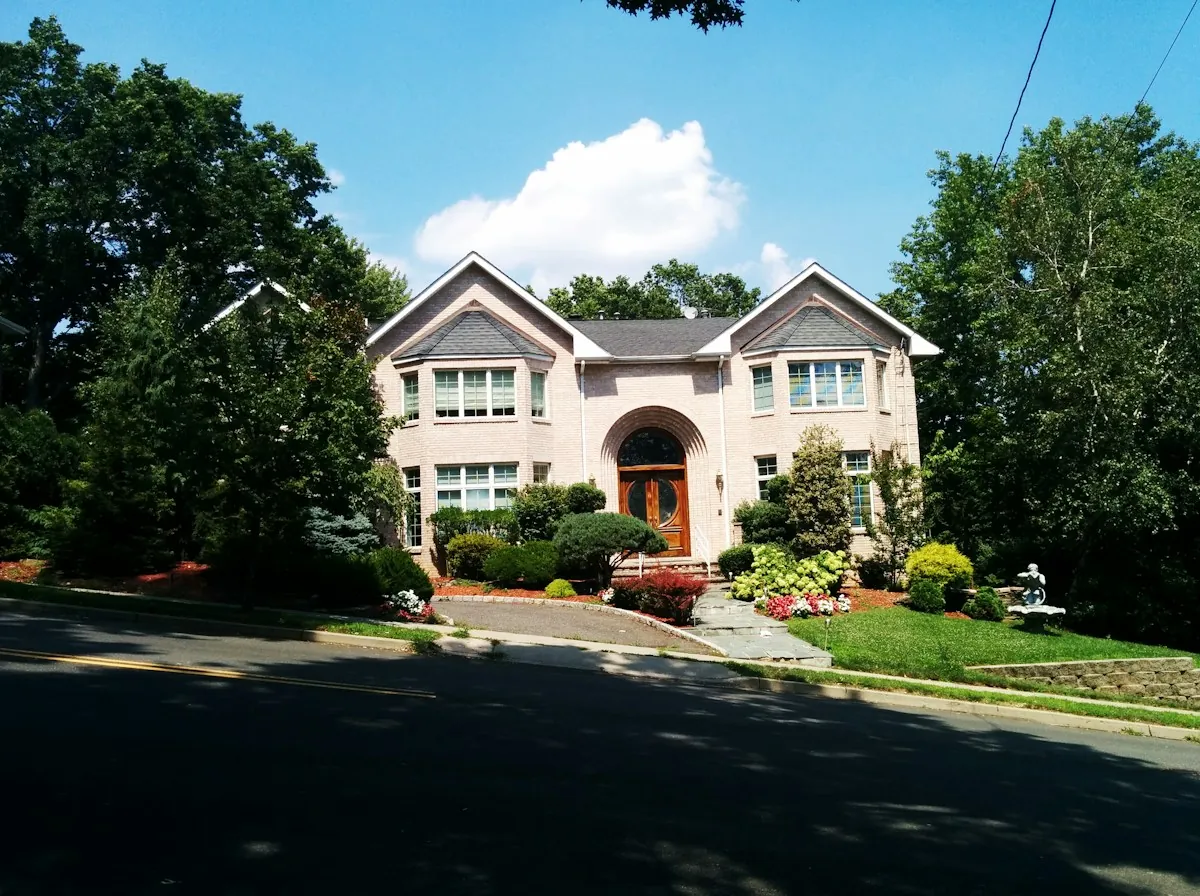
Roof Replacement in Verona, typically $9,500 - $26,000. Inter-war stock. Board decking and narrow lots. Local crew, a free written quote, and the permit pulled through the Verona construction office.
Inter-war stock means board sheathing rather than plywood on a good proportion of it, and that changes what can be fixed over and what has to come off. Compact lots also mean the practical question of where the dumpster goes and where the materials land is a real one rather than an afterthought.
Board decking and a narrow lot are both things you want established before a number is quoted, not after the covering is off.
A small Essex County township north of West Orange around Verona Park, developed largely in the first half of the twentieth century. Older detached and semi-detached housing on compact lots, much of it inter-war, with steeper pitches and more original detail than the post-war townships west of it.

6 lanes of roofing work, each priced against a written scope.
Inter-war housing on compact lots, which means two things a post-war quote would not have to consider.
Board sheathing changes what a repair can do.
Compact lots and mature streets mean a fallen limb often lands across a boundary, and the roof damage gets tangled up with whose tree it was.
Inter-war housing sits right on the boundary: some of it was framed heavily enough for stone and some was not, and the only way to know is to look at the structure rather than the date.
Inter-war extensions are often small, low and tucked between buildings on a narrow lot, so the practical question is how a roll of membrane and a crew get to them at all.
The single most useful thing an inspection settles on inter-war housing is whether the deck is board or plywood.
Three of them you can do standing in your own driveway, before anybody gets a ladder off a roof rack. Apply them here first.
N.J.A.C. 13:45A-17.11 requires the registration number on BOTH sides of a commercial vehicle used for home improvement work, with "HIC reg. #" in lettering an inch high. An unmarked van is not a matter of taste or opinion -- it is a vehicle that does not comply with the rule it is supposed to.
The same regulation puts that number on every advertisement, business document, contract and piece of correspondence distributed in this state. A flyer or a door hanger without one was produced in breach of it, whatever else is printed on it.
Over $500, N.J.A.C. 13:45A-16.2 requires it in writing and signed by both parties, setting out the work and the materials and giving the contractor's legal name and business address. A first name and a mobile number is not a business address.
One township, two trades. The mountain decides.
An 1850s planned community. Real slate, real frames.
Post-war and simple. The layer count is the variable.
High and exposed. Edges first, access second.
Heavy canopy. Valleys, gutters and shaded slopes.
Denser and more multi-family. Unit count decides it.
Large, simple, accessible. Age is the question.
Published ranges and straight answers, before you ring round.
A 1,200 square foot roof in architectural shingle works out at roughly $6,600 to $9,600 on New Jersey rates, before anything the roof itself adds. Note that 1,200 square feet of FLOOR is not 1,200 square feet of roof: pitch, overhangs and dormers mean the roof area on a house that size is commonly a third larger again, which is a frequent source of quotes that look inexplicably far apart.
Usually not, on a house. Replacing the roof COVERING on a detached one- or two-family dwelling is ordinary maintenance under N.J.A.C. 5:23-2.7 -- no permit, no notice, no inspection. Three or more units, an attached building, or anything structural underneath the covering is a different answer, and the office that decides is your own municipality's construction office, not the state's. West Orange is detached enough that no permit is the normal outcome here.
For a standard asphalt roof on an average house, yes -- that is well above the $12,000 to $18,000 most 2,000 square foot houses cost here. But it is an entirely normal figure for natural slate, for a large house, or for a steep and complicated roofline with towers and dormers, which this township has a good deal of. The number on its own does not answer the question. What the quote itemizes does.
Architectural asphalt typically gives 20 to 30 years here and three-tab 15 to 20, with freeze and thaw at the eaves doing more to shorten both than sunlight does. Natural slate outlasts the rest by a wide margin -- often a century or more -- which is why so many slate roofs in this area need their nails, valleys and flashings attended to rather than the stone replaced.
The three-day cancellation notice handed over unprompted. New Jersey figures, not a national calculator.