Flat Roofing in Llewellyn Park from $5. $5 to $14 a square foot installed, and the fall matters more than the membrane. Free inspection and a written quote.
On estate houses the flat areas are small, awkward and visible from somewhere: a tower top, a balcony deck, the flat behind a parapet on a wing. The membrane matters less than how it is dressed into stonework and slate around it, and that detail is the whole job.
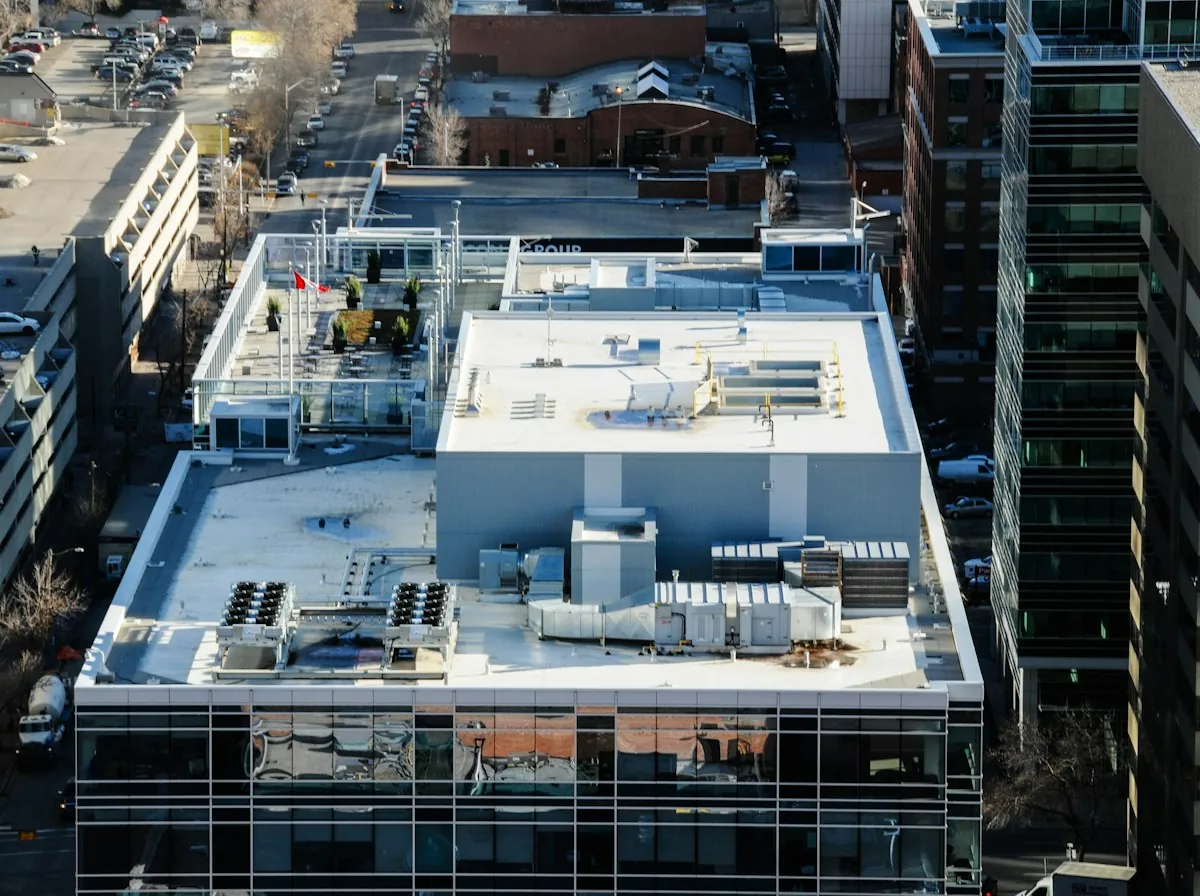
Flat roofing installs at $5 to $14 per square foot in New Jersey: EPDM at $5 to $9 and TPO at $6 to $12 across normal residential work. Most of the flat roofing in West Orange is not a whole building -- it is a rear extension, a porch roof, a dormer top or a garage, sitting alongside a pitched roof and usually draining onto it or through it.


Flat roofing runs $5 to $14 per square foot installed in New Jersey: EPDM at $5 to $9 and TPO at $6 to $12. Almost all of it here is an extension, porch, dormer top or garage sitting next to a pitched roof, which is why the two get specified together rather than separately. Priced from the detail outwards rather than per square. Natural slate at $22 to $35 a square foot, hand work at every tower, dormer and valley, and access up a private wooded hillside that decides a real part of the figure before any material is chosen.
A simple rectangle with a real fall on it, at ground-accessible height, draining somewhere sensible. Most post-war extensions qualify and the work is quick.
Junctions. Where a low-slope roof meets a wall or a pitched slope the detail is the job, and an awkward upstand into stonework or slate takes longer than the whole field of the membrane.
Where the water goes. A deck beneath a large steep slope takes everything that roof sheds, so the outlet is sized for the catchment rather than for the flat area, or it backs up.
This is the most specialized roofing in the township and the least suited to a price per square. Natural slate runs $22 to $35 a square foot, a single broken tile is $200 to $500 to put right properly, and the frames here were built for the weight -- which means replacing stone with stone is a genuine option rather than a structural project.
Access and appearance both matter more here than area does, and neither of them is visible in a quote written from a satellite photograph.
If a quote fails the first two, the rest of it does not matter much.
The regulation asks for the contractor's legal name and business address in the contract. Anything that resolves only to a mobile number is a quote you cannot follow up on if the work goes wrong.
Most of what fails on a roof is not the field -- it is the eaves, the valleys, the chimney abutment and the penetrations. A quote that prices only area has not priced the parts that leak.
The cancellation notice is a legal requirement, not a courtesy. A contractor who includes it unprompted is telling you they expect the quote to survive you thinking about it overnight.
Estate roofs on wooded lots, with towers, dormers and substantial natural slate.
Repairing natural slate is specialist work and priced accordingly -- $200 to $500 for a single tile replaced properly.
Wind that takes asphalt off a suburban roof takes slate off an estate one, and the pieces are heavier and the replacement is specialist.
This is where the township's slate actually is, on frames designed in the 1850s onward to carry it.
On a slate estate roof an inspection is mostly about distinguishing between stone that has failed and fixings that have.
One township, two trades. The mountain decides.
Post-war and simple. The layer count is the variable.
High and exposed. Edges first, access second.
Heavy canopy. Valleys, gutters and shaded slopes.
Denser and more multi-family. Unit count decides it.
Large, simple, accessible. Age is the question.
Inter-war stock. Board decking and narrow lots.
The questions this job turns on, answered up front.
Not in itself. Water that clears within a day or two of rain is normal. Water that is still there a week later is a seam being tested continuously, and it usually means the fall does not actually run or an outlet is not where the low point is.
EPDM runs $5 to $9 a square foot and TPO $6 to $12, and on normal residential extensions either will do the job if the detailing is right. The decision that matters more is how the membrane is dressed into the wall or the pitched roof beside it, because that junction is what fails.
Usually not, on a house. Replacing the roof COVERING on a detached one- or two-family dwelling is ordinary maintenance under N.J.A.C. 5:23-2.7 -- no permit, no notice, no inspection. Three or more units, an attached building, or anything structural underneath the covering is a different answer, and the office that decides is your own municipality's construction office, not the state's. West Orange is detached enough that no permit is the normal outcome here.
It is a Florida rule, and it does not apply in New Jersey. The 25% rule comes from the Florida Building Code Existing Building, where repairing or replacing more than a quarter of a roof within a year can require the whole thing to be brought up to current code. New Jersey has no equivalent provision. It appears in searches here because national content repeats it without saying which state it belongs to, and it is worth knowing that any contractor quoting it at you in this state is citing the wrong code book.
For a standard asphalt roof on an average house, yes -- that is well above the $12,000 to $18,000 most 2,000 square foot houses cost here. But it is an entirely normal figure for natural slate, for a large house, or for a steep and complicated roofline with towers and dormers, which this township has a good deal of. The number on its own does not answer the question. What the quote itemizes does.
The registration number on the paperwork, not just the website. A written scope over $500, as New Jersey requires.